

Use Native Plants to Create a Natural Garden
Article by Josh Smith, Xeriscape Endemic Nursery (XEN)
Consider transitioning a section of your landscape to native plants, where you can reduce both maintenance and water use, conserving a vital resource in this arid valley, along with your own energy.
A side benefit is that you are providing valuable feed and habitat for all sorts of indigenous wild things– from insects to birds, to small and large mammals– by your restoration.
Do not embark on this project unless you are prepared to accept that you are collaborating with your environment, not conquering it.
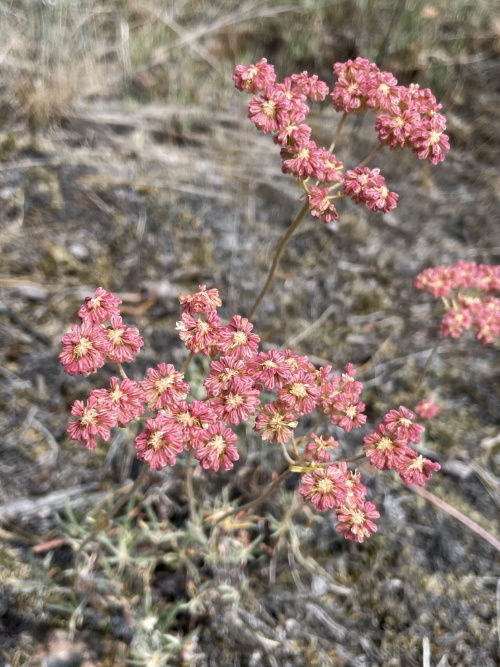
Wild Buckwheat, Eriogonum umbellatum
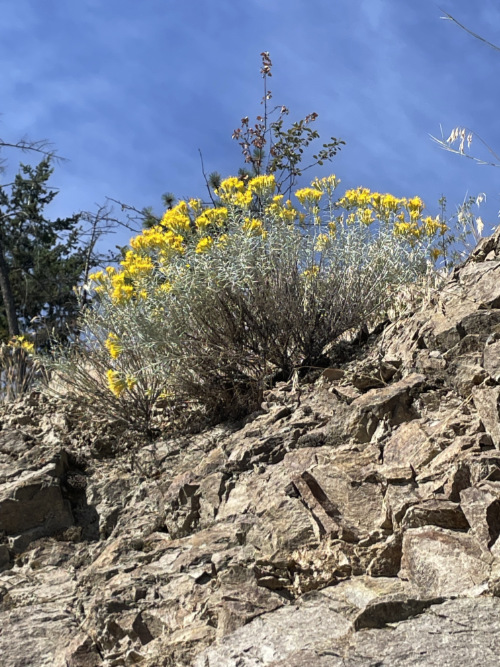
Rabbitbrush, Eericameria nauseosa
WHAT ARE NATIVE PLANTS?
Native vs Endemic vs Exotic vs Naturalized vs Invasive
The scientific definition of a native species is an organism that occurs naturally in a region without human introduction, having evolved there or arrived via natural dispersion over evolutionary time.
- NATIVE plants belong here.
- ENDEMIC plants belong ONLY here.
- EXOTIC plants are introduced by humans from elsewhere.
*NATURALIZED plants are exotic plants that behave themselves.
*INVASIVE plants are exotic plants that are ecologically harmful.
CONSIDERATIONS FOR CHOICES
Consider first where a plant is native— Canada, B.C., or the Interior. Winter cold, summer heat, humidity/precipitation, and competition are all factors in limiting where exactly a plant is native.
Lots of plants native to B.C. are completely inappropriate in the Okanagan, so they’re unlikely to thrive here.
Then, within the Okanagan, first you must also consider whether a plant is native to our particular region of the valley; then, in which ecoregion it belongs: upland, riparian, high elevation, etc.
Further, consider whether it would thrive on a dry silty slope, a creek edge, or in a bed of clay.
Provenance (original seed source) and site matching (right plant, right place) matter more than just choosing a native plant.
Within the Okanagan, there are extremely diverse ecosystems in close proximity to each other, and ignoring sub-regional differences can cause failure unless you are careful to plant native plants in their natural environment.
Elevation, temperature, sun exposure, drainage, and soil texture often matter more than region.
In general though:
- The South Okanagan is hot and dry and of low elevation
- The Central Okanagan is transitional
- The North Okanagan is cooler and wetter
Pre-settlement landscapes in the Okanagan featured native plants that evolved with disturbance, not with watering, fertilizer, or mulch, such as we use on our man-made landscapes. This is a fire-adapted ecosystem that consists of drought-tolerant plant communities in patchy, disturbed, open landscapes.
Many native plants expect stress and respond poorly to pampering, so, as gardeners, we should take advantage of these attributes.
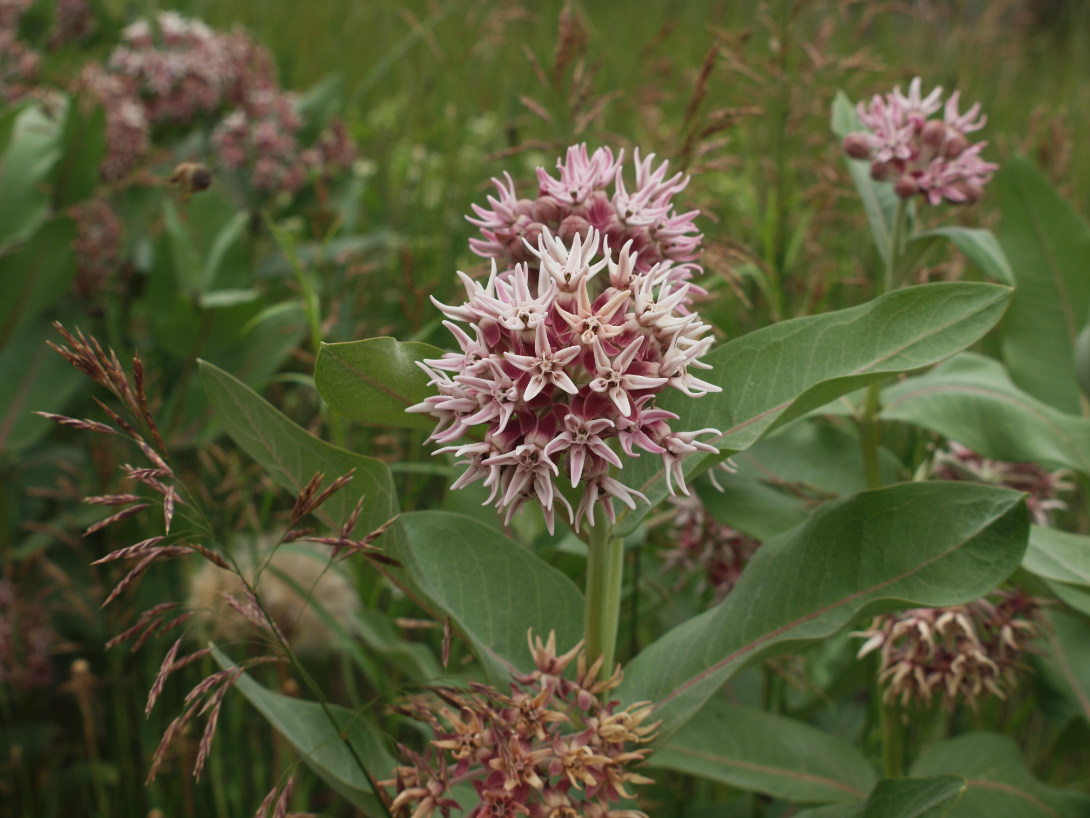
Showy Milkweed, Asclepias speciosa
ADVANTAGES OF NATIVE PLANTS
LESS WATER
The use of native plants in your landscape reduces the amount of supplemental water needed, but it does not necessarily mean they require no water. All plants require enough water when first planted to help them to settle in, so at least for the first year, they are likely to need some supplemental water over the summer and during drought.
LESS MAINTENANCE
Over the longer term, inputs such as fertilizer, replanting, chemicals and other maintenance are greatly reduced with native plants grown in a natural garden. Plants that evolved here are used to our weather swings. This is their home, and they are climate-resilient.
SUPPORT LOCAL ECOSYSTEMS
Native plants also support the local ecology, including pollinators, birds, mammals, and beneficial microorganisms, as well as their companion native plants.
Native plants overwhelmingly provide better habitat than non-native ornamentals and are the entry point for energy into our local ecosystem. They are the foundation of all food webs and feed everything, or everything’s food. Birds depend on insects as part of this food web: over 95% of land-based birds in North America feed insects to their young, and this includes species of birds that exclusively eat seeds as adults.
Birds cannot survive without insects, and insects are highly-specialized and often have evolved specific digestive enzymes and life cycles that require native plants as food or as a larval host for reproduction.
For an extreme example, the Okanagan has some species of butterfly that are at risk or endangered because they have evolved to only use one specific plant, or plant family, as a larval host.
Behr’s Hairstreak Butterfly depends on Antelope Brush; Monarch Butterfly larva can only survive on Milkweeds (Showy Milkweed is the only native here), and the Mormon Metalmark Butterfly relies on Buckwheats.
Human activity and climate change have reduced the population of these plants, which results in a reduced butterfly population, which in turn reduces pollination and seed production for these plants. This type of negative feedback spiral is often the cause of species extinction.
Pollinators also require native plants. Most ornamental, non-native flowers produce nectar that can be used by native adult bees as food, but the 500-600 species of bees native to BC are often pollen specialists that require specific plants or plant families for the pollen they need to feed their larva. Although the bees are very important, flies, other insects, and birds also do their share of pollinating plants.
In addition to pollination services, these insects and birds also often provide pest control, such as being predatory on pests like aphids.