
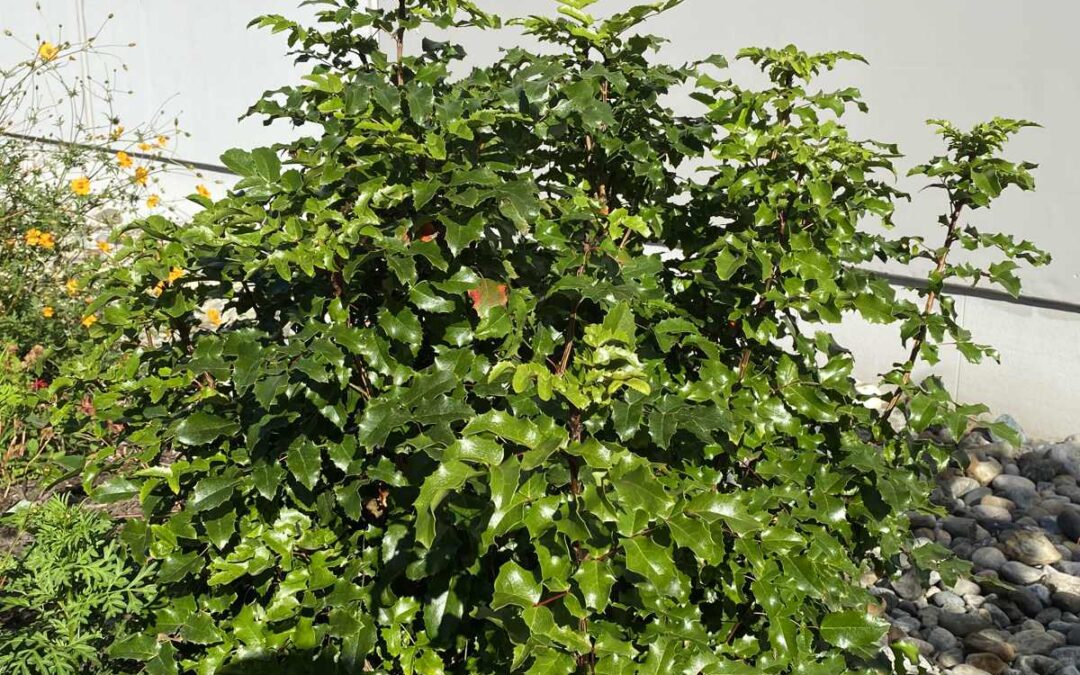
PLANT OF THE MONTH- DECEMBER
by Sigrie Kendrick
Why is Mahonia being reclassified?
For decades, gardeners and botanists have recognized Mahonia as a distinct genus of evergreen shrubs prized for their architectural foliage, fragrant yellow flowers, and ornamental berries. However, recent botanical studies have led to a significant shift in taxonomy, and Mahonia species are now being reclassified under the genus Berberis.
This change stems from genetic research revealing that Mahonia and Berberis are more closely related than previously understood. Traditional classification separated the two based on leaf structure- with Mahonia species typically having compound, holly-like leaves, while Berberis species have simple leaves. Recent advances in DNA analysis show these differences don’t justify maintaining separate genera. The plants share numerous characteristics, including similar flower structures, fruit development, and chemical compounds in their tissues.
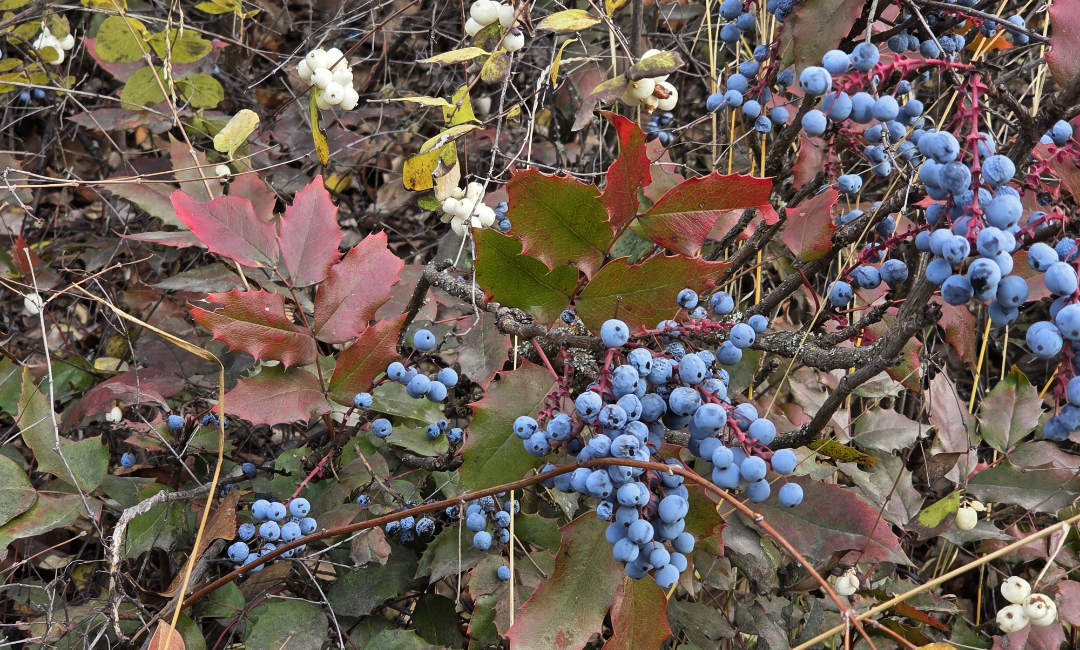
Botanical Science Continues to Evolve
Popular Okanagan natives, once known as Mahonia aquifolium (Oregon grape) and Mahonia japonica are now properly referred to as Berberis aquifolium and Berberis japonica. For gardeners, this change is primarily one of nomenclature. The plants themselves haven’t changed and still offer the same winter interest with their bold evergreen foliage, bright yellow flower clusters that bloom in late winter or early spring, and blue-black berries that attract birds. Their cultural requirements remain identical, thriving in sun to partial shade with well-drained soil.
Nurseries and botanical institutions are gradually adopting the new nomenclature, though many gardeners and plant labels still use the familiar Mahonia name. This transition period can create confusion when searching for plants or information, so it’s helpful to be aware of both naming systems.
Understanding this reclassification helps us appreciate how botanical science continues evolving as new research methods reveal deeper relationships between plant groups.
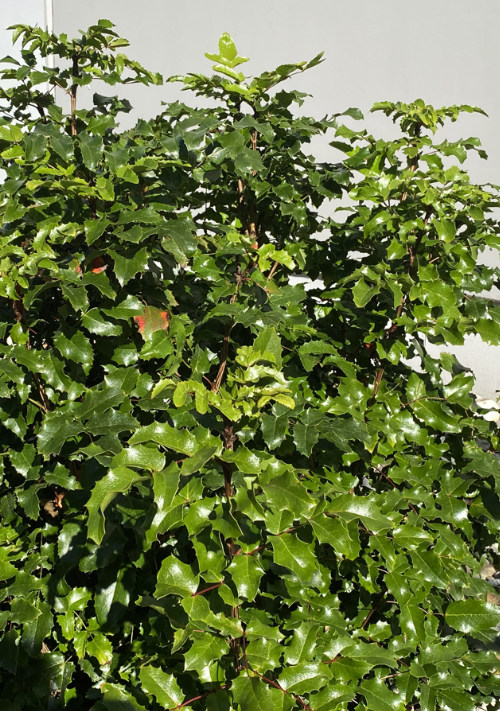
Berberis in the summer
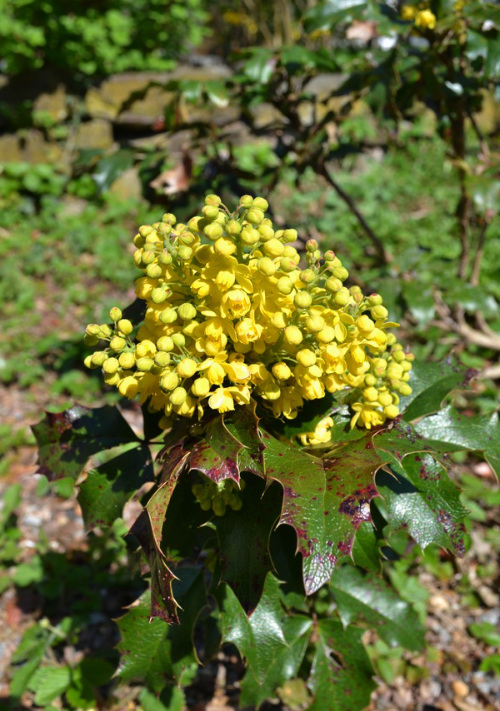
Berberis in bloom in the spring
Sigrie Kendrick is a master gardener and executive-director of the non-profit Okanagan Xeriscape Association.
Our Plant Database features more than 500 plants tested and ideally suited for the unique challenges of gardening in the Okanagan’s extreme climate, iincluding the plants in this article.