
Okanagan Heat: Helping Your Garden Thrive
Building resilient landscapes for a changing climate
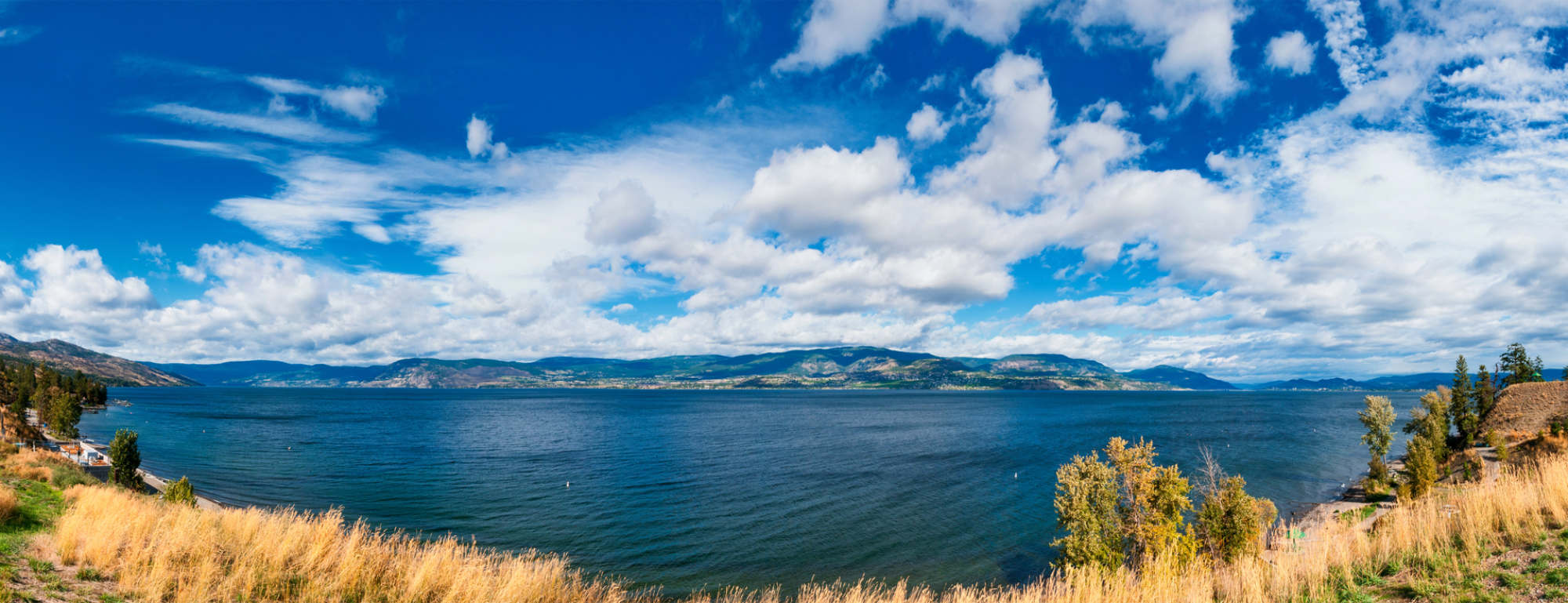
The Okanagan summer is getting hotter.
Much hotter.
And our gardens are feeling it too.
1. THE ISSUE
A Valley Built for Heat– Pushed Beyond Its Limits
The Okanagan has always been hot. It’s part of what makes this valley so extraordinary– those long, sun-drenched summers that ripen world-class fruit, fill patios, and draw visitors from across the country. Our semi-arid climate is not a flaw. It’s what defines us.
But the heat we are experiencing now is different. It is hotter, it arrives earlier, it stays longer, and it is doing things to our landscapes that we have not seen before.
The 2021 heat dome was a turning point. Temperatures in the Okanagan shattered records that had stood for decades. Plants that had thrived in local gardens for years failed overnight. Lawns turned to straw in days. Established trees dropped their leaves in July. Even drought-tolerant plants struggled when the heat became relentless rather than seasonal.
That event was not a one-time anomaly. It was a preview.
Our gardens are not equipped for the new reality. Most of them were designed for a climate that no longer exists.
The good news is that Okanagan native plants have been dealing with exactly these conditions for thousands of years. They have the strategies built in: deep roots, moisture-storing leaves, and a natural resilience to heat that no amount of irrigation can replicate.
By working with the climate we have, rather than the climate we wish we had, xeriscape gardens help landscapes adapt to hotter, drier conditions while reducing water demand, supporting biodiversity, and improving resilience to both drought and wildfire.
Sources: Regional Districts of North Okanagan, Central Okanagan and Okanagan-Similkameen– Climate Projections for the Okanagan Region; University of Waterloo Irreversible Extreme Heat Report via CBC News
2. THE NUMBERS
OKANAGAN HEAT: The Numbers Behind a Changing Climate
The numbers below combine regional climate projections with observed temperature trends to illustrate both where the Okanagan is headed and the changes gardeners are already experiencing today.
6 → 22
Days above 30°C each year
Historically about 6 days. By the 2050s, around 22 days are projected, which is nearly four times as many extremely hot days.
40C
Projected maximum temperature
Kelowna’s projected maximum temperature rises from about 35C historically to 40C by 2051.
2X
Longer heat waves
Average heat waves in Kelowna are expected to increase from 6 days to more than 11 days, giving gardens less time to recover.
2X
Canada’s warming rate
Canada is warming at twice the global average, and the Okanagan is warming even faster than much of Canada.
Already Feeling the Change
Climate projections tell us where we’re headed. Weather records show we’re already getting there. Recent temperature records show that valley-bottom cities like Kelowna and Osoyoos are already experiencing significantly more days above 30°C than in the past, making heat tolerance an increasingly important consideration when choosing plants for Okanagan gardens. OXA’s Plant Database includes heat-resistance ratings to help gardeners choose plants better suited to today’s hotter summers.
Note: The statistic for days over 30C represents a regional average across all altitudes (including mountains).
Also facing water shortages?
Longer, hotter summers place new stresses on plants, soils, and even our neighbourhoods. Discover practical ways to build a garden that can cope with increasing heat while using water wisely.
→ Explore our companion guide– Okanagan Drought: Helping Your Garden Thrive
3. THE FUTURE
The Impact On The Okanagan Garden
Most Okanagan gardeners have felt it– that sinking feeling in late July when the garden that looked so promising in June starts to struggle. Leaves curl. Flowers drop early. Lawns go from green to gold almost overnight. What’s happening is not poor gardening. It’s physics.
Soil moisture disappears faster than you can replace it
In extreme heat, water evaporates from soil at a rate that even regular watering cannot keep up with. Surface soil can dry out completely within hours of watering, leaving roots stressed and plants unable to take up the nutrients they need. The more you water, the more it can feel like you’re losing the battle, because in a conventional garden, extreme heat can quickly overwhelm even regular irrigation.
Plants hit their limits
Every plant has a temperature threshold beyond which it simply cannot function normally. Above that point, photosynthesis slows, growth stalls, and the plant shifts all its energy into survival rather than flowering or fruiting. For plants that evolved in cooler, wetter climates, as many ornamental plants commonly grown in Okanagan gardens did, an Okanagan summer is already pushing those limits. A summer like 2021 pushed them over entirely.
Lawns become the biggest liability
Turf grass is among the most heat-vulnerable surfaces in any garden. It requires enormous amounts of water to stay green in summer, goes dormant quickly under water restrictions, and when it dies back, it leaves bare soil exposed to further evaporation and erosion. A large lawn in an Okanagan summer is essentially a heat and water sink, demanding maximum water input for minimum resilience.
Heat stress makes plants vulnerable to everything else
A heat-stressed plant is a weakened plant. Pests, diseases, and fungal problems that a healthy plant would shrug off can devastate one that is already struggling to survive. Gardeners who find themselves battling repeated pest or disease problems are often dealing with a heat and water stress problem underneath, not a pest problem.
The urban heat island effect
Hard surfaces– driveways, patios, concrete paths, gravel mulches– absorb heat during the day and release it slowly overnight, raising the ambient temperature in your garden above even the surrounding area. This effect compounds on hot days, creating microclimates in your own yard that are several degrees hotter than the air temperature. Strategic planting can counteract this significantly, which is something we will come back to in the solution section.
Drought, heat, and wildfire are not three separate challenges
They are connected expressions of the same changing climate. Longer, hotter, drier summers place stress on our gardens, reduce soil moisture, and create the conditions where wildfire risk increases.
Of the twenty most at-risk municipalities for wildfire in Canada, seven are in the Okanagan. That statistic alone tells you how closely heat and fire are linked in our valley.
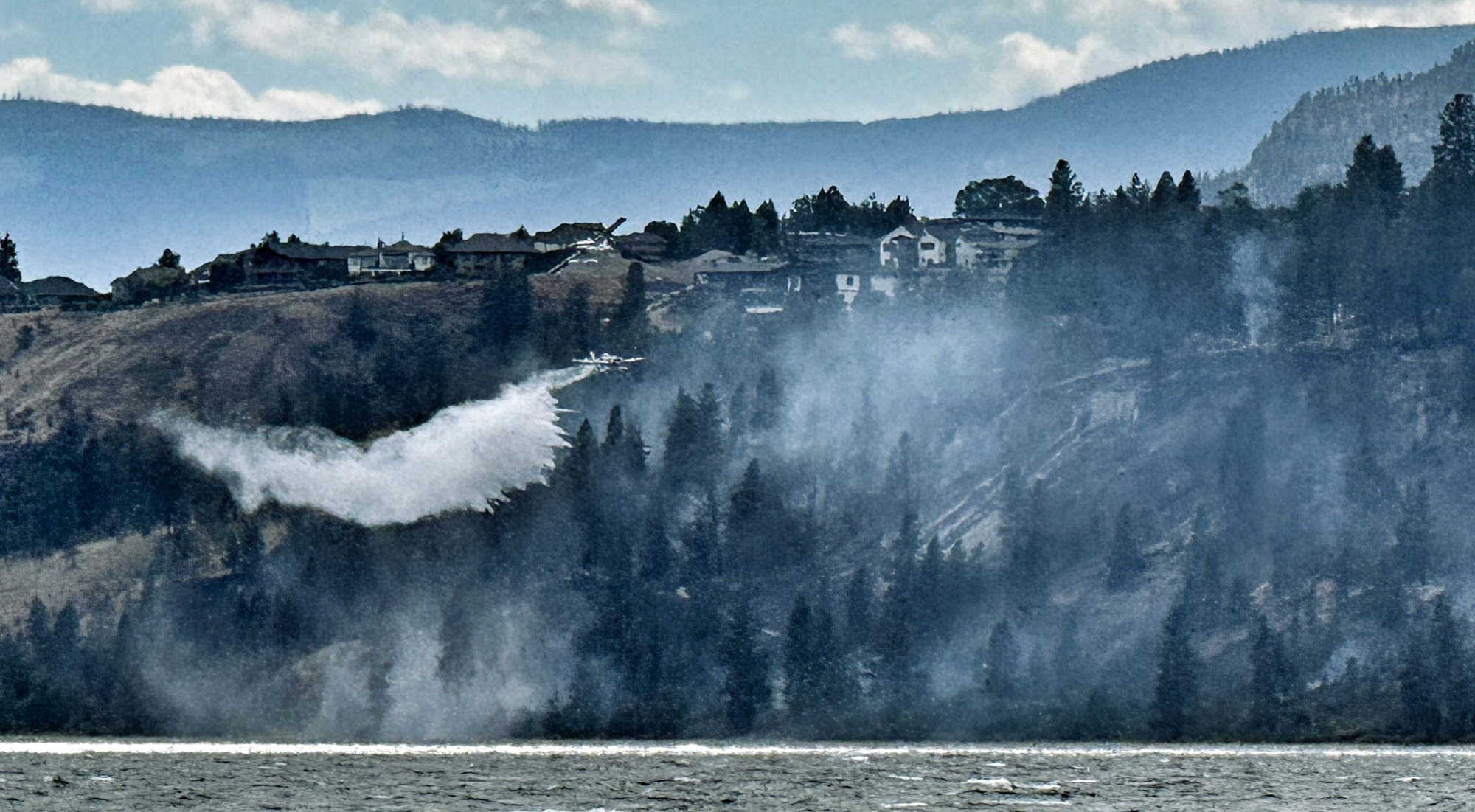
Photo by Lise Guyot @elleguyot
WILDFIRE IS PART OF OUR LANDSCAPE
Wildfires are a natural part of British Columbia’s wildland ecosystems. Without fire, the landscape loses its diversity. Wildfires recycle nutrients, help plants reproduce, and create a mosaic of vegetation that supports a wide variety of wildlife. Fire has always been part of this valley. Lightning strikes alone account for half of all wildfires in BC. People cause the other half.
What has changed is our relationship to it.
Climate change, the expansion of residential and industrial development into forested areas, and decades of fire suppression have altered forest structure significantly. These changes have contributed to fuel buildup and forest health impacts that can make fires burn hotter and spread faster than they once did.
Warmer, drier summers are increasing fire intensity and frequency, and fire risk in our region is highest from June through October– exactly when the Okanagan is at its driest.
Due partly to climate change and partly to the expansion of our communities into forested areas, we are more exposed to wildfire danger than previous generations were. The 2023 fires that tore through the Okanagan were not an anomaly. They are a preview.
Living where wildfires can occur does put your home at risk, but it is entirely possible to reduce that risk through the choices you make in your own yard. Changes made within 10 metres of your home, including the removal of combustible surface materials, will have the biggest impact on your home’s ability to withstand a wildfire.
Sources:
FireSmart BC Landscaping Guide | Building Climate Resilience in the Okanagan
The 30-30-30 Rule:
Know the conditions that create extreme fire risk
Temperature above 30°C
Relative humidity below 30%
Winds above30 km/h.
When these three conditions occur together, wildfire risk increases significantly.
4. THE SOLUTION
Xeriscape Gardening: Designed for a Changing Okanagan Climate
The heat challenges we just described– soil moisture loss, plant stress, lawn failure, urban heat island effect– are not problems that more water solves. They are problems that better plant and design choices solve. This is exactly what xeriscape gardening was made for.
Okanagan native plants have spent thousands of years developing strategies to not just survive our summers but to thrive in them. By choosing heat-tolerant plants and designing landscapes that work with our climate rather than against it, you can have a garden that looks better in July and August than it did in May — with less water, less intervention, and less frustration.

Choose heat-tolerant plants suited to our climate– This is the single most impactful choice you can make. Heat-tolerant plants adapted to semi-arid conditions have built-in strategies that no amount of irrigation can replicate: deep root systems that access moisture far below the surface, waxy or silver-toned leaves that reflect heat and reduce water loss, and the ability to slow their own metabolism during the hottest periods rather than burning out. Native plants are an excellent option.
Heat stress can look very much like drought stress– wilting, leaf scorch, and dieback– even when the soil is still moist. That’s why choosing plants with good heat tolerance is becoming just as important as choosing drought-tolerant plants.
As our summers become hotter, heat tolerance is becoming just as important as winter hardiness. OXA’s Plant Database includes heat tolerance ratings to help gardeners choose plants that are better adapted to today’s Okanagan conditions.
DIG DEEPER– learn more in our Heat Zones blog post
Use shade strategically– Shade is one of the most underused tools in an Okanagan garden. A well-placed deciduous tree or large shrub can reduce the temperature of the soil and plants beneath it by several degrees, which is enough to make the difference between a thriving garden bed and a struggling one. Deciduous trees are ideal because they provide shade in summer when you need it most, then drop their leaves in winter to let light through when the sun is lower, and warmth is welcome.
Shade also counteracts the urban heat island effect directly. Replacing hard, heat-absorbing surfaces with planted areas, or shading them with overhanging plants, measurably reduces the ambient temperature of your entire outdoor space.

Mulch generously and choose wisely– A 5 to 8 centimetre layer of mulch is one of the most effective heat management tools available to any gardener. It insulates soil from temperature extremes, dramatically slows evaporation, and keeps roots cooler on the hottest days. Organic composted mulch has the added benefit of breaking down slowly to feed the soil.
One important note: keep mulch a few centimetres away from plant stems and tree trunks. Mulch piled against stems traps moisture and heat in exactly the wrong place, encouraging rot and disease.
Replace lawn with heat-resilient groundcovers– Lawn is the least heat-resilient surface in most Okanagan gardens. Replacing even a portion of your turf with low-growing, drought-tolerant groundcovers reduces your garden’s heat vulnerability significantly. Good groundcovers shade the soil beneath them, reduce evaporation, require far less water than grass, and stay green and attractive through conditions that would turn a lawn brown.
Creeping thyme, kinnikinnick, and low-growing sedums are among the best performers in our climate — attractive, tough, pollinator-friendly, and genuinely heat-tolerant once established.
Water deeply and less often– Frequent shallow watering encourages roots to stay near the surface where soil temperatures are highest, and moisture evaporates fastest. Deep, infrequent watering– once or twice a week rather than daily– trains roots to grow downward into cooler, more consistently moist soil. This single change makes plants significantly more heat-resilient over time, even before you change a single plant in your garden.
Watering between dusk and dawn reduces evaporation loss dramatically. In peak summer heat, water applied during the day can lose a significant portion to evaporation before it ever reaches the roots.
DIG DEEPER
For the full picture on water-wise gardening in the Okanagan, visit our Okanagan Drought page.
Want to understand exactly how native plants survive our summers at a biological level? Our blog post Built for Drought: How Plants Survive the Heat goes deep on the science– it’s a fascinating read.
Creating Fire-Resilient Landscapes Through Xeriscape
OXA has long recognized that many plants adapted to our semi-arid climate also have characteristics that can contribute to fire-resilient landscapes.
Plants adapted to our semi-arid climate survive our dry summers by storing and conserving moisture. That same moisture retention is exactly what makes them slower to ignite. They tend to have softer, higher-moisture leaves with lower resin and oil content– the opposite of the dry, resinous conifers and cedar hedges that give wildfire its momentum.
Some plants take this further. Sempervivum, the humble hens-and-chicks familiar to most Okanagan gardeners, store so much moisture in their leaves that they can remain virtually untouched when surrounding plants have burned. They are also essentially zero-water once established. That is the xeriscape advantage in one small, tough, beautiful plant.
Native plants are your strongest crossover choice
Native plants are not only adapted to our climate– they are also part of the ecological systems that developed alongside fire in this region. They use less water, are better suited to surviving and recovering from fire, and are more likely to regrow afterwards rather than leaving bare, erosion-prone soil behind. As demand for native plants grows, more Okanagan nurseries are beginning to stock them.
Many of the plants in OXA’s Plant Database are both drought-tolerant and fire-resilient, and our database is designed specifically for Okanagan growing conditions. For gardeners interested in exploring additional planning resources, the FireSmart™ Plant Chart and the Make Water Work Plant List offer complementary information that may be helpful when selecting plants for particular landscapes.
Because plant performance also depends on site conditions, soil, maintenance, and local microclimates, no single plant list can predict how every species will perform in every garden. If you’re unsure which plants are best for your property, your local nursery or an OXA expert can help.
Note: OXA members have access to our very helpful Ask An Expert benefit.
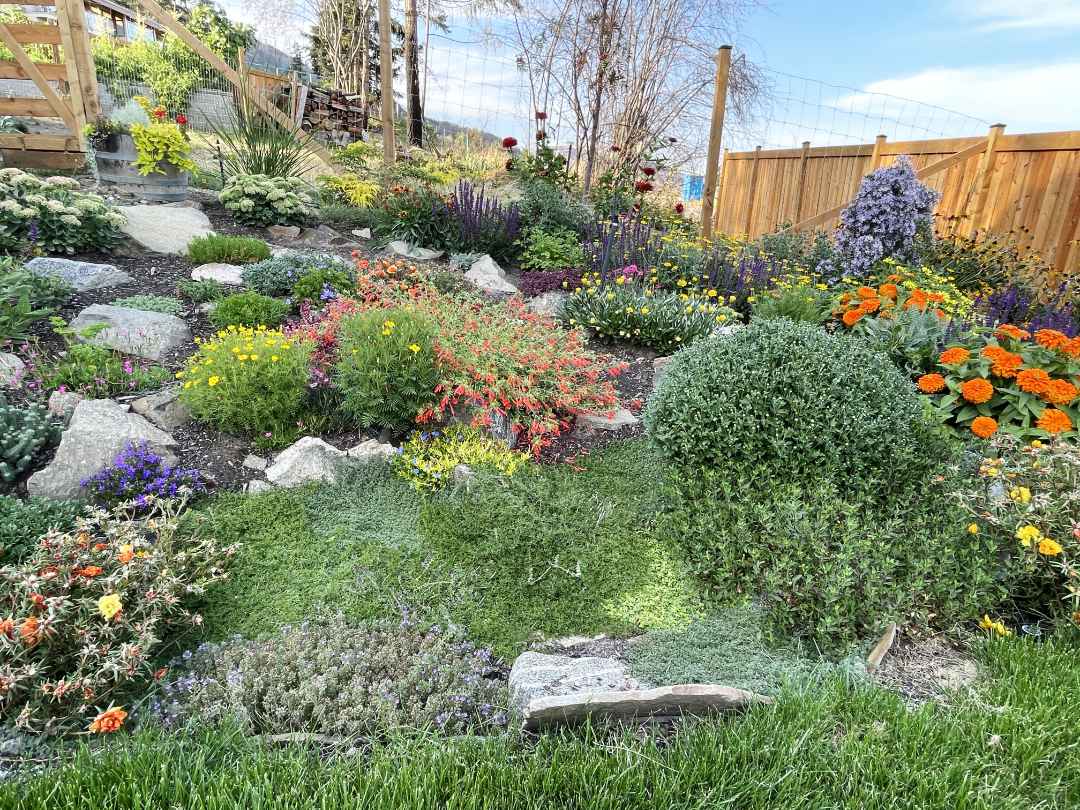
Want to go deeper?
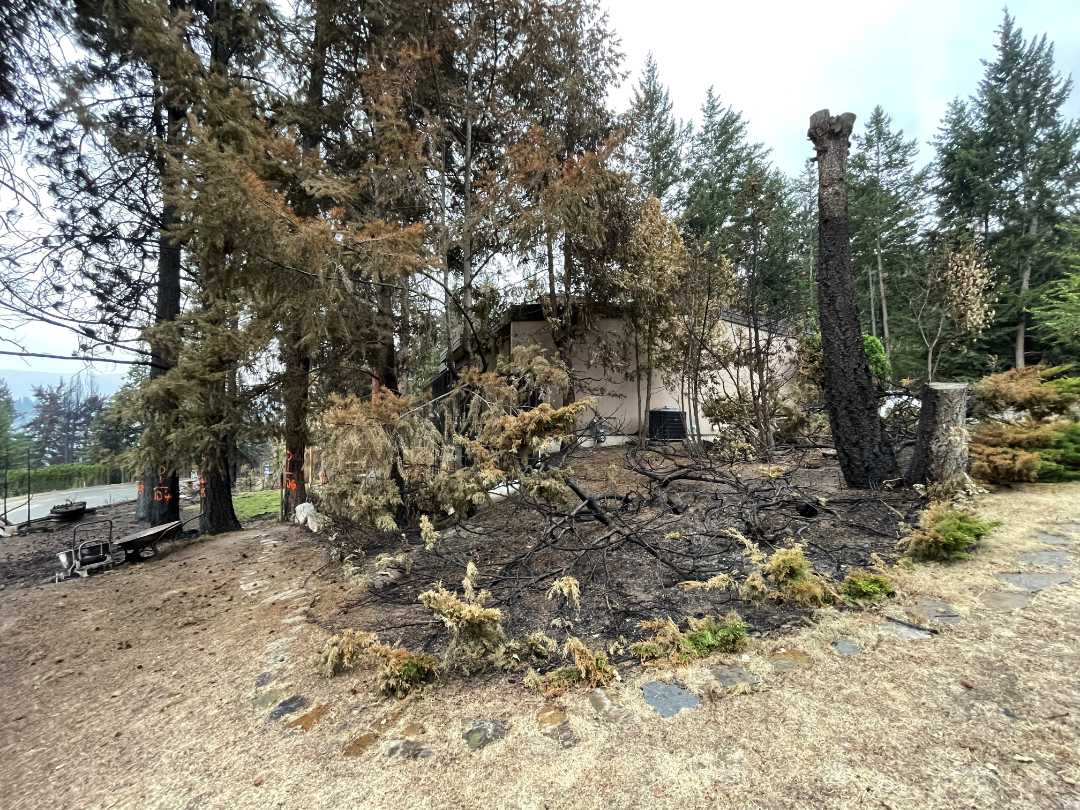
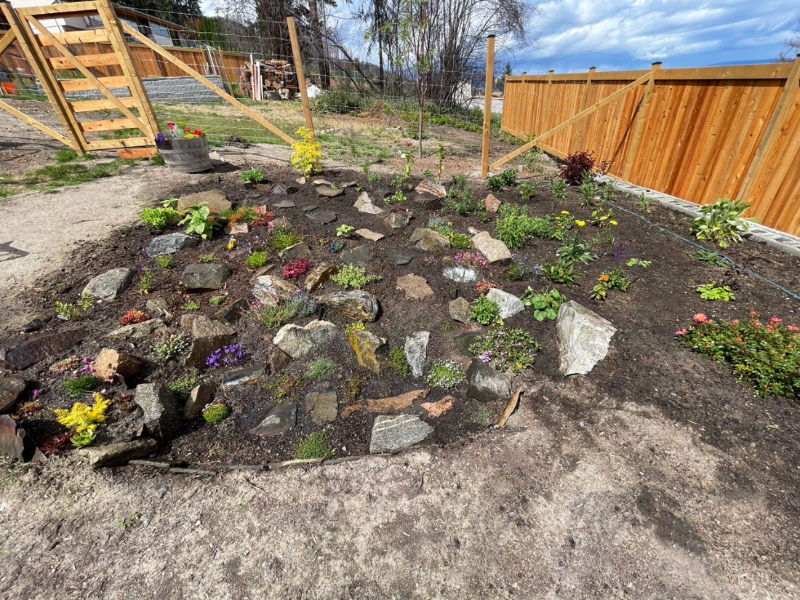
For a firsthand account of rebuilding a garden after wildfire, read Wildfire Recovery– a blog post by Judie Steeves, whose home survived an Okanagan wildfire but whose garden did not. Our post Fire-Smart Plant Choices profiles three outstanding native plants that deliver on both fire resilience and water conservation.
Additional Fire-Resilience Resources
“You can be FireSmart, water smart, and have a beautiful landscape!”
The Three Priority Zones
FireSmart™ organizes the space around your home into three priority zones.
Immediate Zone — 0 to 1.5 metres should be maintained as a non-combustible surface, free of dead plant material and woody debris.
Intermediate Zone — 1.5 to 10 metres is where plant choice and spacing have the biggest impact on how fire moves toward your home.
Extended Zone — 10 to 30 metres focuses on reducing vegetation density and giving firefighters room to work.
Changes within 10 metres of your home will have the biggest impact overall — and remember that 50 per cent of home losses in wildfires are caused not by direct flame contact but by embers landing close to the structure.

For the full zone-by-zone guide, including a worksheet to assess your own property, plus serveral other useful guides visit FireSmartBC.ca.
Practical FireSmart™ Landscaping Tips
These best practices are drawn from the FireSmart™ BC Landscaping Guide and apply to any Okanagan property.
Around your home:
- Remove all dead plant material, leaf litter, and debris from around your home regularly. These are prime ember-catching fuel sources.
- Space plants and shrubs so they do not form a continuous path of vegetation toward your home.
- Prune tree branches to a height of 2 metres from the ground to prevent fire travelling from ground level up into the tree canopy.
- Space tree crowns at least 3 metres apart to prevent fire spreading from tree to tree.
- Remove any branches that overhang your roof or hang within 3 metres of your chimney.
Lawn and groundcover:
- Water lawn deeply and infrequently (approximately 2.5 cm once or twice a week) to keep it as green as possible during dry periods.
- Introduce clover to maintain a green lawn with less water use.
- Replace sections of lawn with fire-resistant groundcovers and shrubs.
- Keep grass cut to no greater than 10 cm.
Mulch and surfaces:
- Avoid combustible mulches such as bark or pine needles within the immediate zone around your home.
- Use gravel, rock, or other non-combustible materials as ground cover close to structures.
- Use decorative rock, stone pathways, and retaining walls to naturally interrupt planting continuity.
A note from OXA
FireSmart™ guidance provides an important framework for reducing wildfire risk. As with any landscape recommendation, OXA encourages homeowners to consider their specific property, local conditions, plant choices, and the overall design of their landscape.

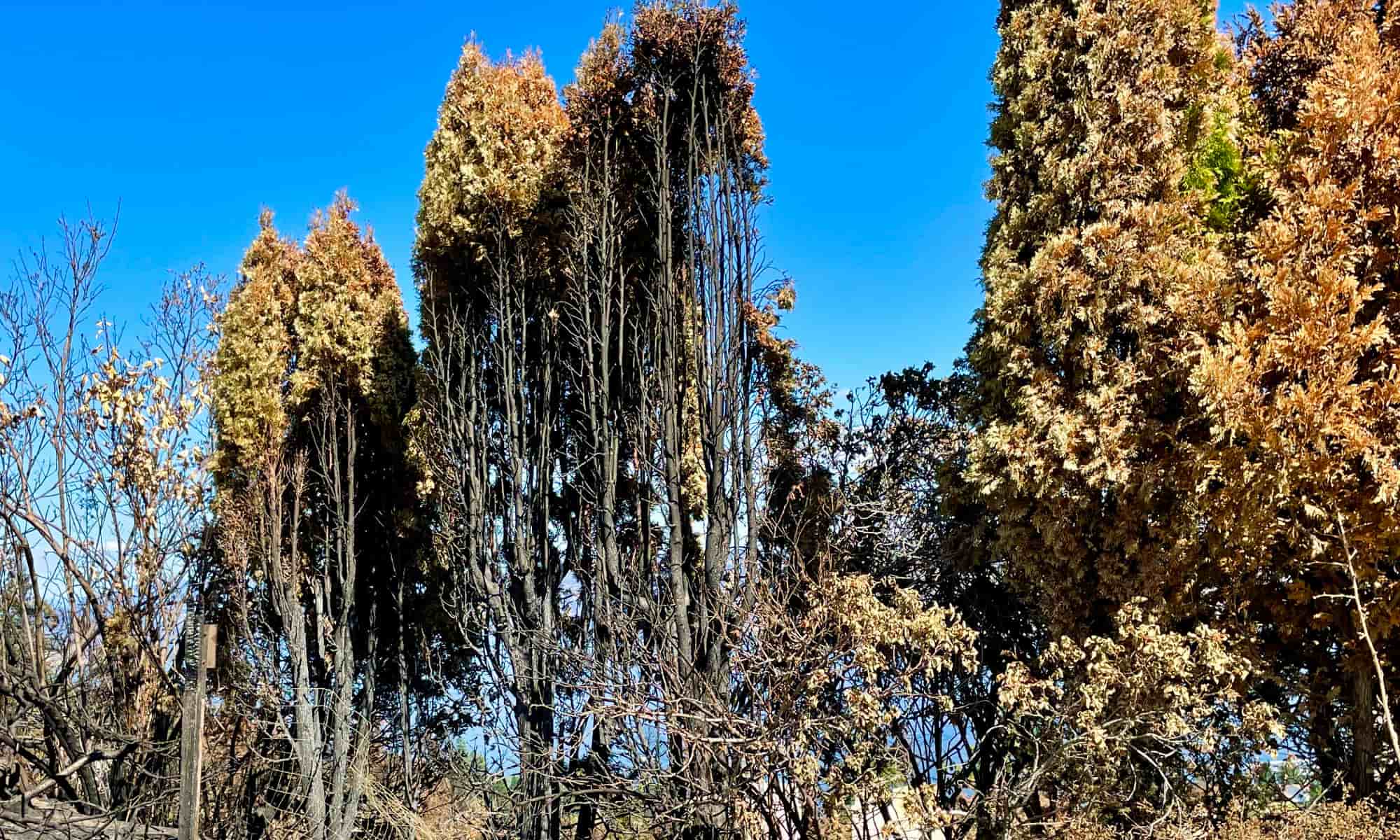
Cedar hedges — a special note
Cedar hedges are the single most common high-risk landscaping feature in Okanagan neighbourhoods. They are dense, they are resinous, and they typically contain dead foliage in their core and on the ground. Worst of all, they are typically planted in long, continuous runs that create the perfect fuel corridor directly toward homes. If replacing your entire hedge feels overwhelming, start by removing the sections closest to your home and replacing them with a fire-resistant, drought-tolerant alternative. The FireSmart™ BC plant tool can help you find beautiful replacements suited to our hardiness zone.
Dig Deeper– check out our blog page for these articles– Hedging Alternatives, Groundcovers, and Fire-smart Plant Choices
BRINGING IT ALL TOGETHER
Crossover Landscaping: Gardens That Handle Heat, Drought and Fire
The idea that water-wise and fire-resilient landscaping can work together is not just an OXA theory– it is already being put into practice by municipalities facing the same challenges as the Okanagan.
The City of Kamloops, located in the Thompson Valley under almost identical semi-arid conditions, has actively embraced exactly this crossover approach– promoting xeriscape principles alongside FireSmart practices as a combined community resilience strategy.
Their program recognizes what gardeners in our valley are beginning to understand: that choosing plants suited to our climate is the single most powerful thing a homeowner can do for both water conservation and fire resilience at once.
Not every low-water plant is automatically fire-resilient — some drought-tolerant plants like juniper can actually increase fire susceptibility, which is why plant choice matters as much as gardening approach. But the overlap between heat-tolerant, drought-tolerant, and fire-resilient plants is substantial, and designing your garden to hit all three targets is entirely achievable.
Along with replacing lawns with groundcovers, using hardscaping strategically, and plant placement, the main crossover principles for Okanagan gardens are–
- Choose double-duty plants. Look for plants with deep root systems, heavy or waxy leaves, and high moisture content. These characteristics tend to deliver on heat tolerance, drought tolerance, and fire resilience simultaneously.
- Go native wherever possible. Native Okanagan plants are the ultimate crossover choice. They are adapted to our heat and drought cycles, more likely to survive and recover from fire, and more likely to support local pollinators and wildlife. As more nurseries stock native species, they are also becoming easier to source.
Sources: Crossover Landscaping; Changing Climate | Xeriscaping and FireSmart in Kamloops
TAKE ACTION
Ready to put climate resilience into practice?
Every change you make– whether it’s replacing part of your lawn, planting a native shrub, or adding mulch to protect your soil– helps build a garden that’s better prepared for the Okanagan’s changing climate. Start with the resources below and take the next step when you’re ready.
- Learn–
Explore Articles on Xeriscape Gardening
Browse our blog for practical advice on native plants, lawn alternatives, mulch, groundcovers, shade, and climate-resilient gardening in the Okanagan. - Choose Plants–
Search OXA’s Plant Database
Filter by native plants and browse our curated selection of drought-tolerant plants suited to Okanagan conditions. Pay attention to Heat Zones. - Plan Your Landscape–
Explore the Make Water Work Plant List
Browse more than 100 trees, shrubs, grasses, and perennials– including plants identified for both water-wise and FireSmart landscapes. - Protect Your Property–
Book a Free FireSmart Home Assessment
Receive personalized recommendations to help improve your property’s wildfire resilience.
Together, thousands of individual gardens can make a meaningful difference across the Okanagan– cooling neighbourhoods, conserving water, supporting biodiversity, and building resilience for the future.
Your garden, your choices, your community.

The Okanagan Xeriscape Association gratefully acknowledges the Central Okanagan Foundation for its generous grant funding, which made the research, development, and creation of this community drought resource possible. We are proud to partner with organizations dedicated to strengthening environmental resilience across the Okanagan Valley.

We respectfully acknowledge the Syilx Okanagan Nation and their peoples, in whose traditional, ancestral, unceded territory our demonstration gardens are situated.