
NATIVE PLANT ADAPTATIONS
As wildfires have swept across the Okanagan this summer, forcing thousands from their homes and leaving blackened hillsides in their wake, it’s easy to see fire only as catastrophic. And for those of us living through evacuation alerts and orders, smoke-choked skies, and the loss of homes and livestock, it is exactly that– a disaster deserving our full sympathy and support. But step back into the shrub-steppe and dry forest that surround our valley, and a different story unfolds. Long before skyscrapers and subdivisions, fire moved through our landscape on a fairly regular basis, and the native plants that make up our natural heritage evolved not merely to endure it, but in some cases to depend on it. Understanding these adaptations doesn’t diminish the real grief of this fire season but it does offer a longer view, and some genuine hope for what regrows.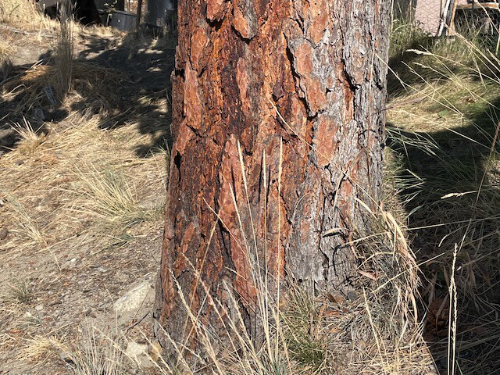
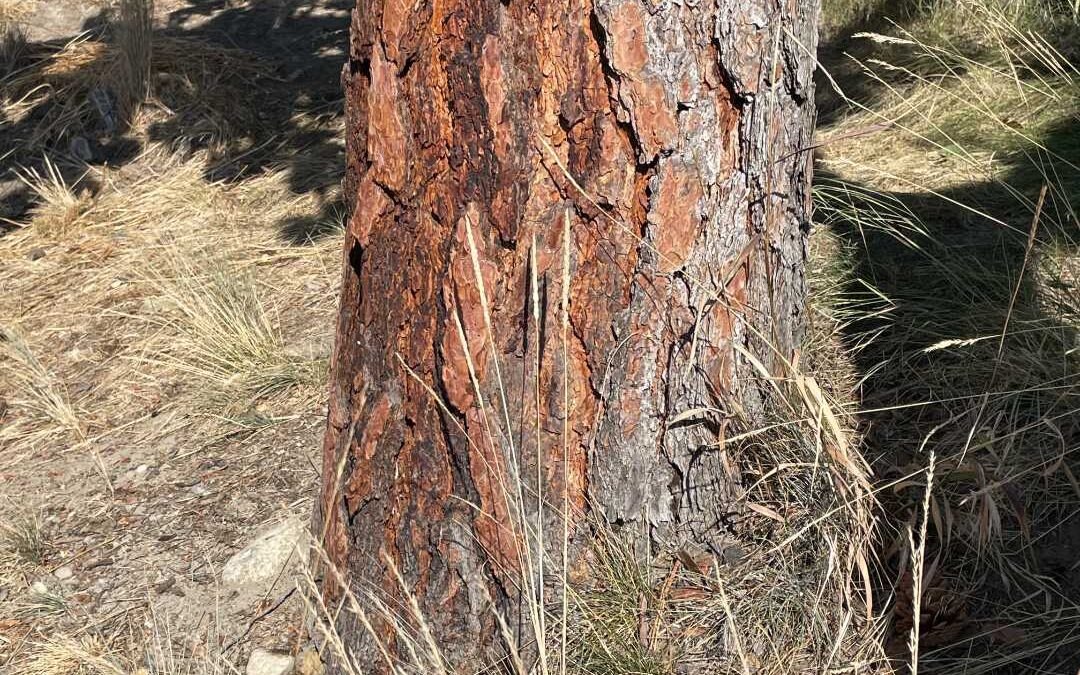
Ponderosa Pine Photo by Judie Steeves

Smooth Sumac – Okanagan native plant
HOW ARE NATIVE PLANTS BUILT FOR FIRE?
PONDEROSA PINE (Pinus ponderosa) is one of the clearest examples of a species built for fire.
Mature ponderosas feature thick, plated, corky bark, often several centimetres deep, that insulates the living cambium beneath from the heat of a passing surface fire. The cambium layer is the growth area of the trunk which annually produces new bark and wood in response to hormones.
Pinus ponderosa lower branches self-prune as the tree matures, lifting the canopy out of reach of ground-level flames, and their needles are held in tight, moisture-retentive bundles that resist ignition compared to the fine, resinous foliage of some other conifers.
Below ground, a deep taproot anchors the tree and taps moisture other species can’t reach, letting it stand through drought as well as fire.
Ponderosa forests historically burned every decade or two in low-intensity fires that cleared underbrush without killing the big trees, which is precisely why decades of fire suppression, followed by hot, fuel-laden fire seasons like this one, can be so devastating.
Today’s fires often burn hotter and higher than the ones these trees are built to shrug off.
SMOOTH SUMAC (Rhus glabra) has broad leaves with high moisture content that lack volatile oils found in many xeric plants.
Similar to Ponderosa, Sumac also shed their lower branches as they mature, creating a separation from ground-source fuels.
Sumac spreads by rhizomes, lateral roots that send up new stems some distance from the parent plant, and after a fire top-kills the visible shrub, those root systems resprout vigorously from buds below the soil surface, often producing denser thickets than existed before the burn.
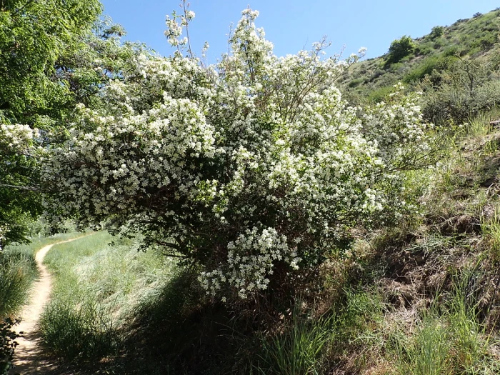
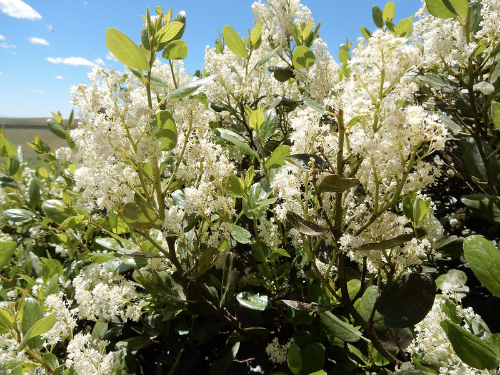
MOCK ORANGE (Philadelphus lewisii) shares this resprouting strategy. Its root crown, the tissue where stem meets root, just at or below ground level, holds dormant buds that are protected from all but the most severe fires.
When top growth is lost, Mock orange resprouts from this crown, often flowering again within a few seasons, making it a valuable presence in post-fire slope stabilization and habitat recovery.
SNOWBRUSH CEANOTHUS (Ceanothus velutinus) has perhaps the most striking relationship with fire of all. Its seeds have such hard, impermeable coats that they can lie dormant in the soil for decades and, by some estimates, over a century, waiting for a cue they may never receive without fire.
The heat of a burn, in the range of roughly 80 to 95°C, scarifies that seed coat and triggers germination, while the fire itself clears competing vegetation and leaves a nutrient-rich ash bed behind.
The result is often a dense flush of Ceanothus seedlings in the first spring after a burn, acting as a nitrogen-fixing pioneer species that helps rebuild soil fertility for the plant community that follows. Snowbrush also resprouts from its root crown, giving it a second pathway back after the flames pass.
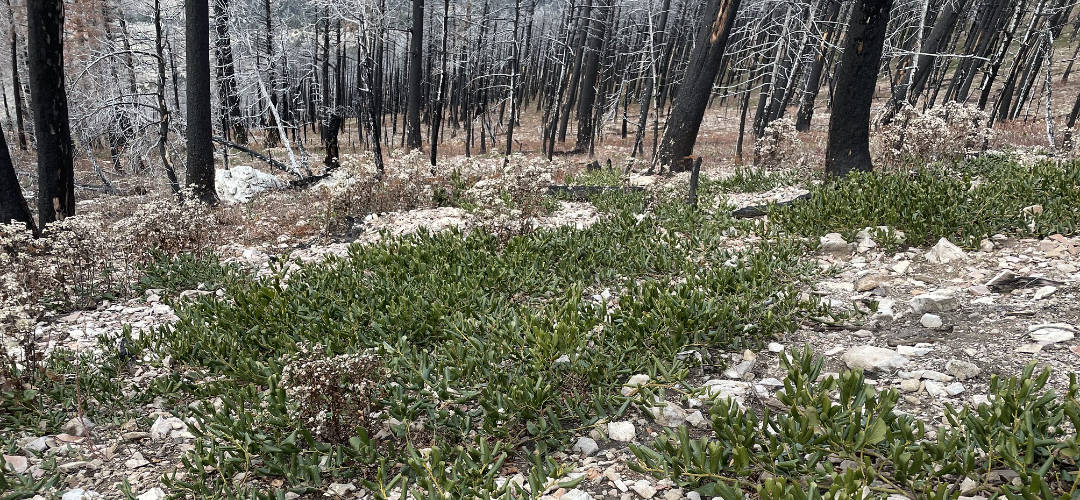
Snowbrush Ceanothus growing after forest fire
Matt Lavin | Wikimedia Commons (CC BY-SA 2.0)
For those of us practicing and promoting xeriscaping in the Okanagan, this fire season is a hard but useful reminder of why native, drought-adapted plants belong in FireSmart landscaping conversations, not just water conservation ones.
Species like these didn’t simply survive fire by accident– they built it into their life cycles over thousands of years in our valley.
As recovery begins in the areas affected by this month’s fires, Ponderosa pine, Sumac, Mock orange, and Snowbrush are reclaiming the burned slopes, evidence of these species surviving exactly as they always have.
DIG DEEPER –
For more information, read our blog post on Fire-smart Plant Choices and our in-depth page Okanagan Heat: Helping Your Garden Thrive
The Okanagan Xeriscape Association extends its thoughts to everyone affected by this season’s wildfires, and encourages residents to consult FireSmart BC for guidance on fire-resilient landscaping around homes.
Article by Sigrie Kendrick – a master gardener and executive-director of the non-profit Okanagan Xeriscape Association.