
Okanagan Water restrictions
Originally published July 29, 2026. This article was written during the summer 2026 drought and water restrictions, but the water-saving strategies and advice for protecting plants remain relevant for future drought conditions.
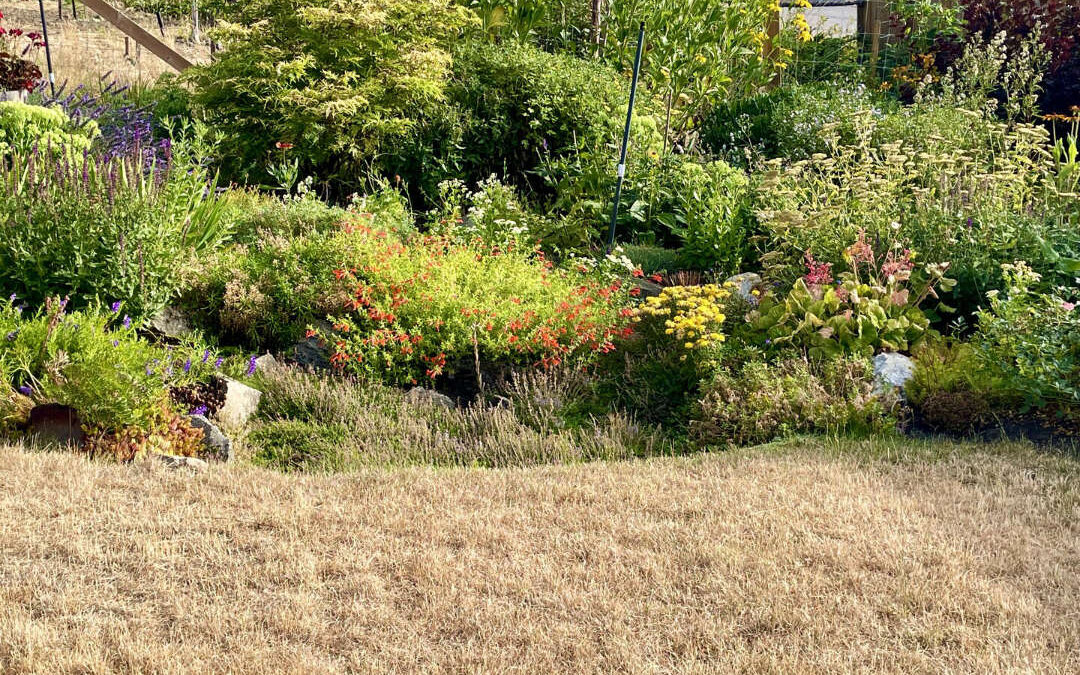
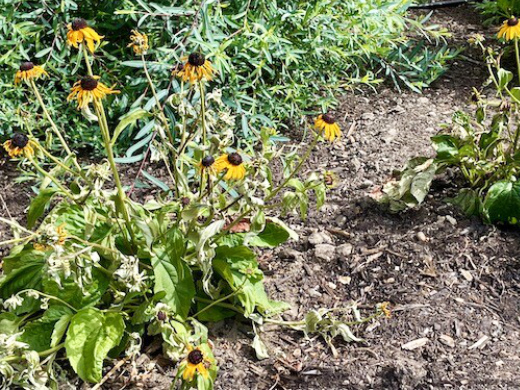
It’s disheartening to see your favourite perennials turning brown with shrivelled leaves and drooping flowers, and it’s frustrating to see lawns turn brown instead of lush and green, but that’s today’s reality.
There are steps you can take to help save plants, but you must let the lawn go in times of severe water shortage. It’s more important to conserve enough water for indoor domestic use and other essential needs than to keep lawns green.
That’s not only my opinion. That’s the law.
Due to urgently declining water reservoir levels, the City of West Kelowna has now joined the cities of Vernon and Peachland and other Okanagan communities in imposing Stage Three outdoor watering restrictions. That means you may only irrigate one day a week and you may not water the lawn at any time or in any way; wash your car, deck or patio; or fill your pool, hot tub or water feature.
More than 90 million litres of water a day flow through the two treatment plants operated by the City of West Kelowna, rapidly emptying upland reservoirs that are at lower-than-normal levels.
Okanagan Lake, which is also a water reservoir, was at its lowest level in 80 years of records, but most of the City of Kelowna, which mainly uses that as its source of water, remained at Stage One restrictions, permitting outdoor watering three days a week.
Kelowna users who received their water from the McCulloch Lake reservoir were under Stage Two restrictions and could irrigate only two days a week. Lake Country and Penticton were also at Stage Two. Osoyoos moved to Stage Three late in the summer.
No communities permit outdoor watering during the heat of the day, with most restricting it to overnight and until 10 or 11 am.; and again in the evening from 6 or 7 pm.
The next step is Stage Four restrictions, when no outdoor watering will be permitted, to prioritize water for essential indoor needs and firefighting. With no end to the heat and drought in sight, if we don’t do more now to conserve water, we are likely to be forced to that extreme.
How to Save Plants During Drought
All is not lost, however. You can protect your investment in trees, shrubs, and other plants, including vegetables, by hand-watering them during the early morning and evening hours on any day of the week to supplement the limited irrigation that’s allowed.
This will have been helped if you transitioned your garden to xeriscape, planting native and drought-tolerant species that thrive with less or no supplemental irrigation.
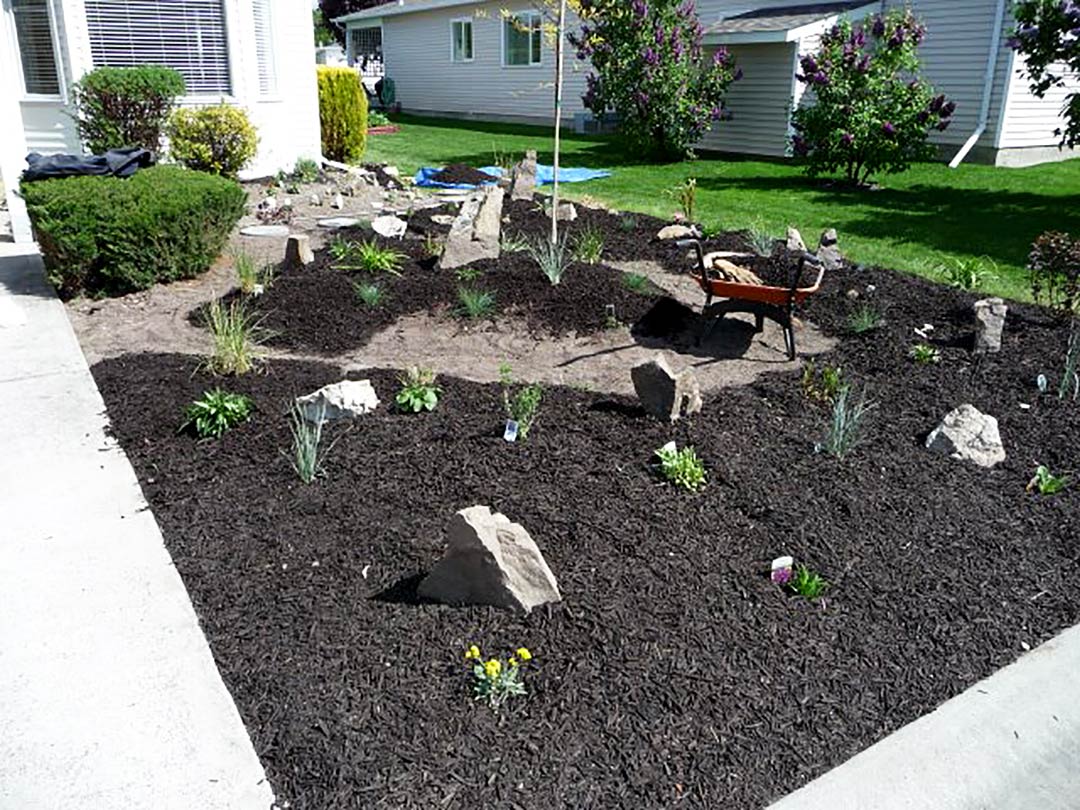
Mulch Helps Gardens Hold Moisture
Applying a generous layer of mulch is one of the simplest and most effective ways to help your garden withstand drought conditions. A 7 – 10 cm layer of organic mulch using compost, woodchips, shredded bark, or straw acts as an insulating barrier that dramatically reduces evaporation from the soil surface, keeping moisture available to plant roots for longer between waterings. Mulch also moderates soil temperature, preventing the extreme heat spikes that stress roots and drive plants into moisture-conserving survival mode.
As organic mulch breaks down, it improves soil structure and water-holding capacity over time, creating a positive feedback loop where healthier soil retains water more efficiently.
When applying mulch, keep it a few centimetres away from plant stems and tree trunks to avoid rot and pest issues, and top it up annually as it decomposes.
Let Your Lawn Go Dormant During Drought
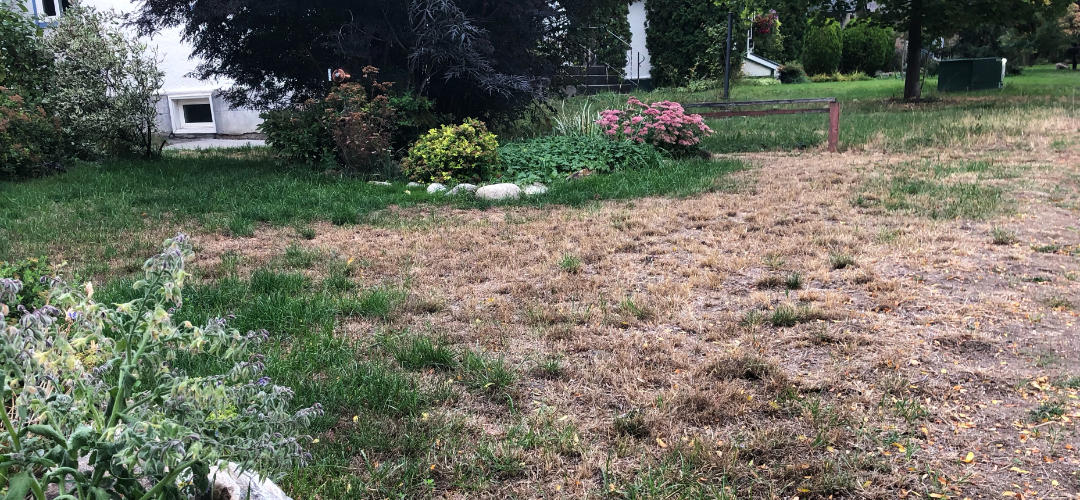
Don’t worry about the survival of your lawn under drought conditions. One of the most valuable yet underused drought strategies in the Okanagan is simply allowing lawns to go dormant.
Traditional turf grasses, like Kentucky bluegrass and fescue, common in most residential lawns, are cool-season species, meaning they’re genetically programmed to grow vigorously in spring and fall and to shut down growth during summer heat.
During dormancy, the grass blades turn brown and stop growing, but the crown and root system remain alive underground, conserving energy and water until cooler, wetter conditions return.
Homeowners can support this natural process by simply reducing or withholding irrigation once dormancy begins, rather than fighting it with constant watering.
Lawns typically green up again within a couple of weeks of renewed rainfall or irrigation once temperatures moderate, making dormancy a low-effort, water-wise choice.
DROUGHT LEVEL 4 — JULY 2026
In July 2026, the province of B.C. designated the Okanagan Valley as Drought Level 4 due to extreme dry conditions and a shortage of water supplies.
It’s a warning to us all to take extreme measures to conserve water.
For more drought information and current updates, check the OBWB website.
Sigrie Kendrick is a master gardener and executive-director of the non-profit Okanagan Xeriscape Association.