
GARDENING WITH NATURE
Article by Sigrie Kendrick
Xeriscape plants don’t simply survive the Okanagan’s hot, dry summers– they are uniquely adapted to thrive in them. Drought tolerance isn’t only about anatomy; it’s also about strategy.
There is a common misconception that xeriscape plants are simply tough plants–
survivors that endure poor conditions through grit alone.
The truth is far more fascinating and takes a dive into the biology of drought-tolerant plants.
The plants that thrive in the Okanagan’s hot, dry summers are not suffering through the season.
They are engineered for it, shaped by millions of years of adaptation.
Understanding what makes these plants work isn’t just interesting science but the foundation of smarter gardening in one of Canada’s most water-stressed regions.
Much of what makes a drought-tolerant plant exceptional happens where we humans can’t see it.
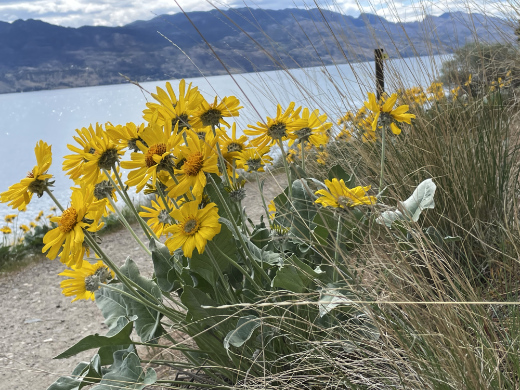
Arrow-leaf balsamroot
Photo by Judie Steeves

Blanketflower
Photo by Judie Steeves
Root Adaptations That Find Hidden Water
Root architecture is the first and perhaps most important adaptation.
Okanagan natives such as Bitterroot (Lewisia rediviva), Arrow-leaf balsamroot (Balsamorhiza sagittata), and Prairie smoke (Geum triflorum) develop stout, fleshy taproots one to three metres deep, accessing subsoil moisture that shallow-rooted ornamentals never reach.
This taproot also serves as a storage organ, stockpiling carbohydrates and water that sustain the plant through the harshest stretches of summer drought.
So efficient is this adaptation that Bitterroot, one of our region’s most iconic natives, can survive being uprooted for weeks and still revive when replanted.
Other species such as Bluebunch Wheatgrass (Pseudoroegneria spicata) and Blanketflower (Gaillardia aristata) develop dense, wide-spreading fibrous root systems that fan out through the upper soil horizon, capturing even the lightest rainfall before it can evaporate. Unlike deep taproots, these fibrous networks maximize surface area, drawing moisture from a broad swath of soil.
Xeriscape plants also invest heavily in their root systems relative to their above-ground growth. A modest-looking plant in your garden may be hiding twice its visible mass underground, allowing it to access moisture deep within the ground during the dry months of July and August heat.
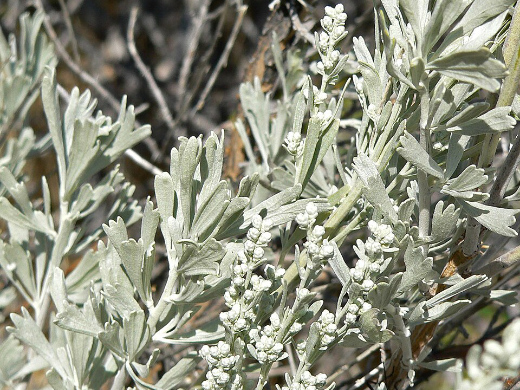
Artemisia
Stan Shebs | Wikimedia Commons | CC BY-SA 3.0
Leaf Features That Reduce Water Loss
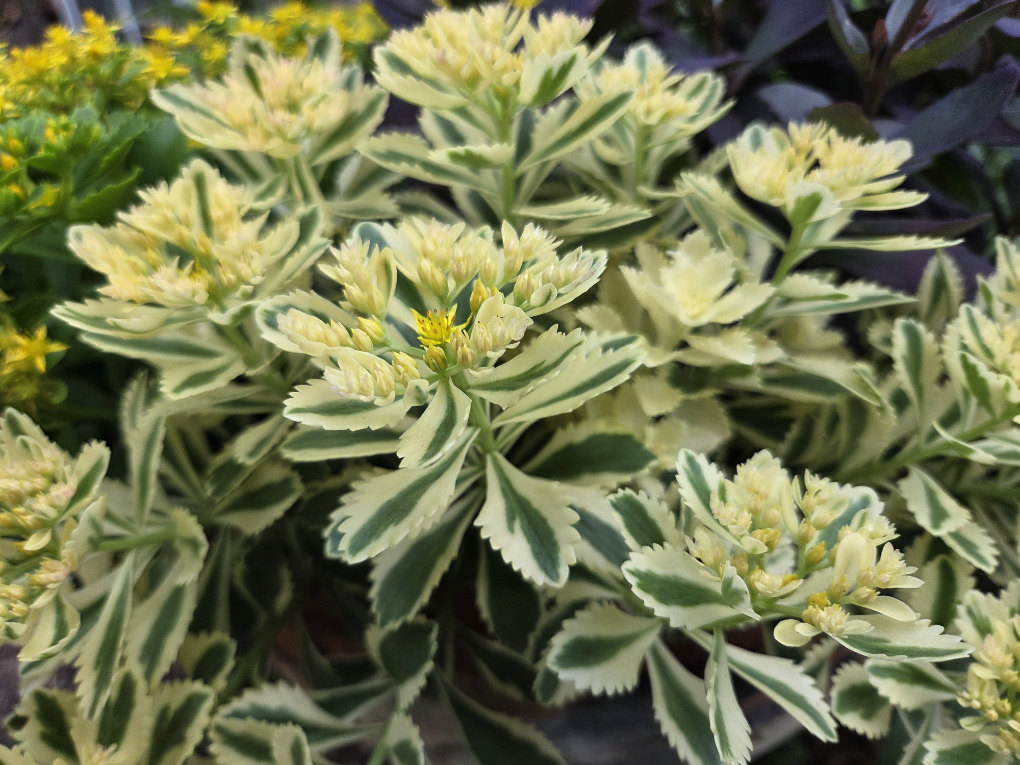
Above ground, a plant’s drought strategy is written plainly in its foliage if you know how to read it. Silver and grey leaves, so characteristic of Okanagan favourites like Artemisia and Salvia/Sage, aren’t simply a colour choice. Reflective leaf surfaces bounce back intense ultraviolet radiation, lowering leaf temperature and dramatically reducing water lost through transpiration. Run your fingers along the leaves of many of these plants, and you’ll feel the fine hairs, known as pubescence, which create a humid micro-layer at the leaf surface, buffering hot, desiccating wind. Smaller leaves are another common signature. Reduced surface area means reduced water loss, which is why Thyme and other tiny-leaved plants handle heat with such ease. Waxy cuticles serve a similar purpose, forming a vapour barrier on the leaf epidermis that cuts transpiration in dry conditions. Some plants go further still with Sedums, Sempervivum, and other succulents storing water directly in fleshy leaves and stems, which act as a reserve they draw upon when rainfall disappears for months at a time.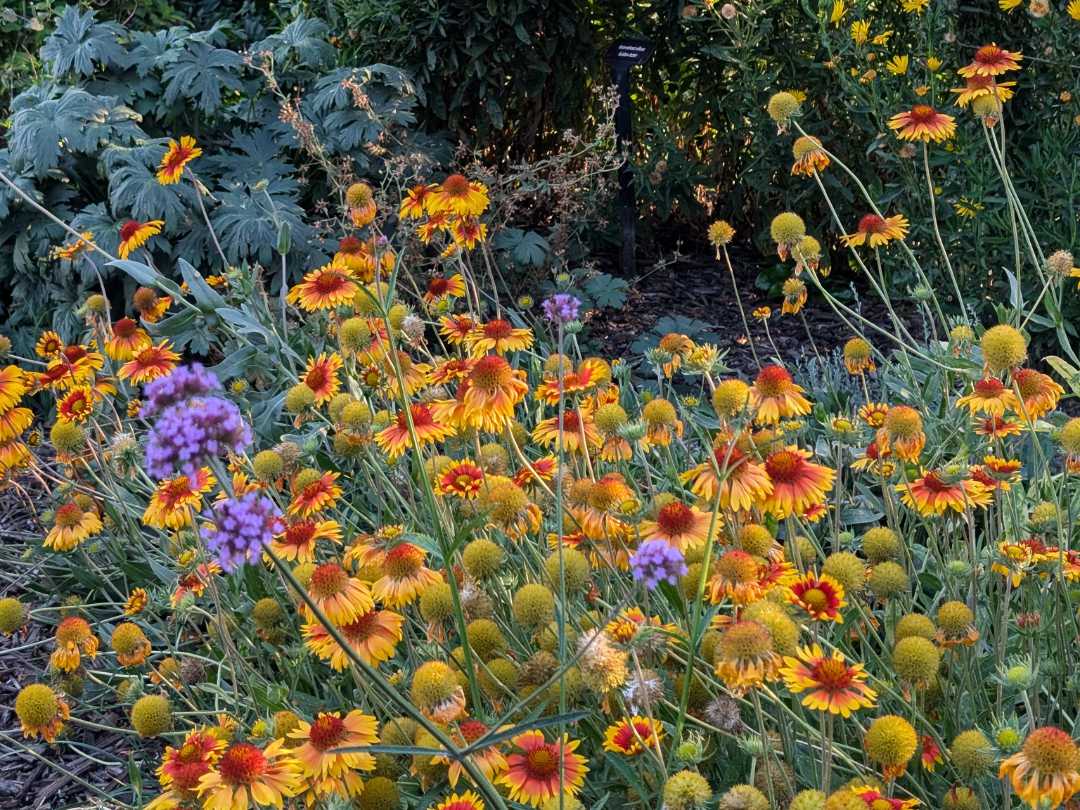
Blanketflowers in an Okanagan garden
Photo by Judie Steeves